Back to Castles

Lednice Castle

Lednice, South Moravian

UNESCONeo-GothicWine regionMoraviaEnglish park

Visit duration

3–8 h

Today availability

9:00–17:00

Paid entry

70–300 CZK

Official Website

Visit website


Description

  • UNESCO World Heritage Cultural Landscape — 200 km² of designed parkland
  • Exquisite Neo-Gothic interiors: carved wood ceilings, original parquet, and Liechtenstein collections
  • Minaret — a 60-metre Islamic-style tower in the middle of Moravian wine country
  • Greenhouse (1843) — one of the finest 19th-century palm houses in Central Europe
  • Heart of the Czech wine region — September wine festivals on-site

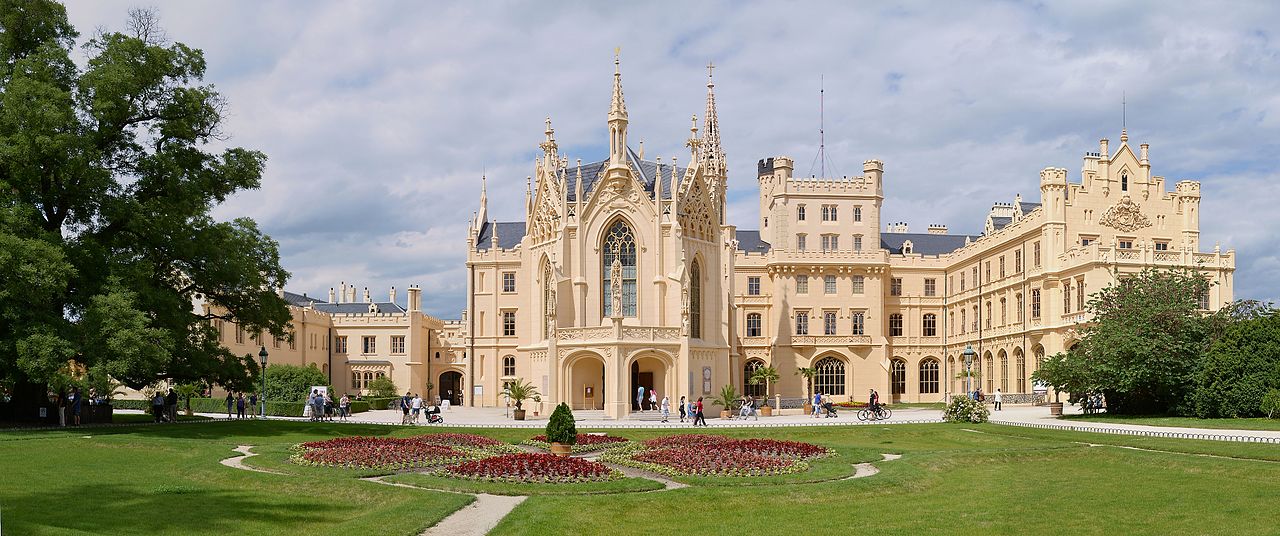
Lednice Castle rises from the flat plains of South Moravia, Czech Republic, near the Austrian border, its intricate Neo-Gothic spires and turrets reflected in a wide ornamental lake. The chateau is the centrepiece of the Lednice-Valtice Cultural Landscape, a 200-square-kilometre designed park that was inscribed on the UNESCO World Heritage List in 1996 as one of the largest artificially created landscape compositions in Europe. The surrounding countryside — a mosaic of formal gardens, woodland rides, fishponds, and vineyard slopes — was shaped over four centuries by the Liechtenstein family into something closer to a curated work of landscape art than a conventional castle estate.

The history of Lednice as a Liechtenstein seat stretches back to 1332, when the family first acquired the property. For over six hundred years — one of the longest unbroken associations between a noble dynasty and a single estate anywhere in Central Europe — the Liechtensteins systematically expanded and transformed both the castle and the landscape around it. The current Neo-Gothic appearance of the chateau dates from a major reconstruction between 1846 and 1858, designed by the Viennese architect Heinrich Koch. Koch's design drew heavily on English Gothic Revival influences and created the distinctive tower, which anchors the skyline of the entire estate. The Liechtenstein family retained ownership until 1945, when the estate was confiscated after the Second World War under the Beneš decrees.

Among the many follies and structures scattered across the park, the minaret is perhaps the most startling. Built between 1798 and 1804 at the request of Prince Alois I of Liechtenstein, the 60-metre tower has no religious function — it was designed purely as a landscape ornament, a fashionable Romantic-era expression of the taste for the exotic. No less extraordinary is the greenhouse, constructed in 1843–1845 by the English engineer P. H. Devien: a vast iron-and-glass palm house that was among the most technically advanced buildings of its time and remains one of the finest examples of nineteenth-century glasshouse architecture in Central Europe. The UNESCO designation encompasses the whole cultural landscape including Valtice Castle, 10 kilometres to the south.

Lednice sits at the heart of the Czech wine country, surrounded by some of the most productive vineyards in Moravia. The September wine festival at the castle is one of the most atmospheric events in the region. The village is small but has good bicycle-hire facilities, and the recommended way to experience the full extent of the park — with its Janův hrad neo-Gothic hunting lodge, Roman aqueduct, and Reistna chapel scattered across the landscape — is by cycling the well-marked UNESCO trail that links the sites. A seasonal boat service along the Dyje river also connects Lednice directly to Janův hrad as an alternative to cycling.

Founded

13th century

Style

UNESCO

Region

South Moravian

Plan your visit

Everything you need to know before visiting the castle

Opening Hours

Lednice Castle panoramic view with Neo-Gothic façade in South Moravia, Czech Republic
Feb–Apr
10:00–16:00

Closed: Monday–Friday

Weekends only

May–Jun
9:00–17:00

Closed: Monday

Jul–Aug
9:00–17:00

Open daily including Monday

Sep
9:00–17:00

Closed: Monday

Oct
9:00–16:00

Closed: Monday

Weekday hours may be limited — check website

Nov
10:00–16:00

Closed: Monday–Friday

Weekends only

Closed in: December, January

* Park and gardens free year-round. Each tour route (Representative Halls, Private Apartments, Greenhouse, Minaret, Children's Rooms) has separate tickets and hours. Check the official website for current tour times before visiting.

Tickets & Tours

Representative Halls

ground floor — ballrooms, dining rooms

50 min
Adult
300 CZK
Senior / Youth (18–24)
240 CZK
Child (6–17)
90 CZK

* Tours conducted in Czech; English written guide provided.

Private Princely Apartments

first floor

50 min
Adult
300 CZK
Senior / Youth (18–24)
240 CZK
Child (6–17)
90 CZK

Greenhouse

1843 Palm House

30 min
Adult
160 CZK
Concession
80 CZK

Minaret Tower

25 min
Adult
140 CZK
Concession
70 CZK

* Climb the 60-metre Islamic-style minaret for panoramic views over the park and vineyards.

Free entry: Park and gardens free year-round. Children under 5 free.

* Each attraction requires a separate ticket. Budget for multiple tickets if you want to see everything. The park alone is worth a visit at no cost.


Getting There

Lednice Castle panoramic view with Neo-Gothic façade in South Moravia, Czech Republic
Car
Drive from Brno via Route 52 and Route 422, approximately 40 minutes.

From Prague about 2.5 hours via D2 motorway.

40 min

Train
Train to Břeclav station, then hourly bus 570 to Lednice.

About 50 minutes from Brno total.

50 min

Parking
Parking available

Free parking area approximately 300 metres from the castle entrance. Larger paid parking lot near the ticket office. Cash needed for some parking areas.


Visitor Tips

  • Budget a full daythe park alone takes 2–3 hours to explore properly, and there are 6 separate attractions.

  • Combine with Valtice Castle (10 km away) for the full UNESCO Lednice-Valtice Cultural Landscape experience.

  • Rent a bike or take the seasonal boat service to explore the parkthe distances between follies (minaret, Janův hrad, aqueduct) are too far to walk comfortably. The boat runs along the Dyje from Lednice to Janův hrad in spring and summer.

  • Visit in September for the wine festivalthe castle's historic wine cellars open for tastings.

  • The minaret is one of the most surreal sights in the Czech Republica 60-metre Islamic tower in the middle of a Moravian vineyard. Do not skip it.

Frequently Asked Questions

Find answers to the most common questions about visiting this castle

How do I get to Lednice Castle from Prague?
Lednice is about 270 km from Prague, making it a long day trip or, better, an overnight stop. By car, take the D1 motorway towards Brno and then the D2 south towards Břeclav, turning off for Lednice — the drive takes approximately 2.5 hours. By public transport, take a fast train or bus to Brno (around 2.5 hours), then a train to Břeclav station and an hourly bus 570 onwards to Lednice. The whole journey from Prague takes 3–4 hours each way, so a base in Brno or Mikulov is strongly recommended.
Is Lednice Castle open year-round?
No — the castle interiors close in December and January, and are only open at weekends in February–April and November. Full opening (Tuesday to Sunday) runs from May through September, with July and August being the only months when the castle is open every day of the week. The park and gardens are accessible free of charge throughout the year, even when the buildings are closed. Always check the official website before visiting, as hours and specific tour times change seasonally.
What is the minaret at Lednice and can I climb it?
The minaret is a 60-metre Islamic-style tower built between 1798 and 1804 in the park about 2 km from the castle. It was commissioned by Prince Alois I of Liechtenstein purely as a decorative garden folly — it has no religious function and was built at a time when Romantic-era architects favoured exotic architectural references in landscape design. Yes, visitors can climb the tower's interior staircase to a viewing platform with panoramic views over the estate, vineyards, and floodplain forests. A separate ticket is required (around 140 CZK for adults).
What is the UNESCO Lednice-Valtice Cultural Landscape?
The Lednice-Valtice Cultural Landscape is a 200-square-kilometre designed parkland in South Moravia inscribed on the UNESCO World Heritage List in 1996. It is considered one of the largest landscape garden complexes in Europe. The landscape was shaped over four centuries by the Liechtenstein family, who systematically connected their two main residences — Lednice Castle and Valtice Castle, 10 km apart — with a network of tree-lined avenues, canals, ornamental lakes, and garden follies including a minaret, a triumphal arch, a Roman aqueduct, and a Baroque chapel. The two castles are best experienced together over one or two days, with the recommended route being by bicycle along the marked cycling trail.
Can I combine Lednice and Valtice in one day?
Yes, and it is the recommended way to visit both UNESCO sites. The two castles are just 10 kilometres apart by road, or roughly 12 kilometres along the cycling trail through the park. If driving, you can visit both interior tours in a single day. If cycling, plan for a full day to allow time for both castle interiors, the minaret, and the landscape in between. Start at Lednice in the morning when the interiors are busiest, ride to Valtice in the afternoon, and end the day with a tasting at the National Wine Salon in Valtice's historic cellars.
What can you see inside Lednice Castle?
Lednice has four separately ticketed attractions. The Representative Halls (ground floor) cover the grand ballrooms, dining rooms, and state apartments. The Private Princely Apartments (first floor) include the castle library with its celebrated double-spiral staircase — one of the most photographed interiors in Czech Republic. The 1843 Greenhouse is a separate iron-and-glass palm house in the grounds. The Minaret, 2 km from the castle, can be climbed for panoramic views over the park and vineyards. Each requires a separate ticket; tours of the castle rooms are conducted in Czech with a written English guide provided.
Who lived in Lednice Castle?
Lednice Castle was the primary residence of the Liechtenstein family — one of the oldest noble dynasties in Central Europe — for over six hundred years. They first acquired the estate in 1332 and retained it until 1945, when it was confiscated under the post-war Beneš decrees. During that time the Liechtensteins systematically shaped both the castle and the surrounding 200 km² park into one of the most ambitious designed landscapes in Europe, culminating in the current Neo-Gothic appearance built between 1846 and 1858. The Liechtenstein family continues to exist today as the ruling dynasty of the Principality of Liechtenstein.

Castles nearby worth exploring

Discover other castles close to your location and continue your journey

Valtice Castle designed by Johann Bernhard Fischer von Erlach in South Moravia

Valtice Castle

7 km away
UNESCOBaroque
Buchlov Castle on a forested hilltop in Buchlovice, Moravia

Buchlov Castle

49 km away
GothicMedieval
Veveří Castle on a wooded peninsula above Brno Reservoir

Veveří Castle

53 km away
GothicBrno
Vranov nad Dyjí Castle on a cliff above the Dyje River gorge

Vranov nad Dyjí Castle

73 km away
BaroqueMoravia